

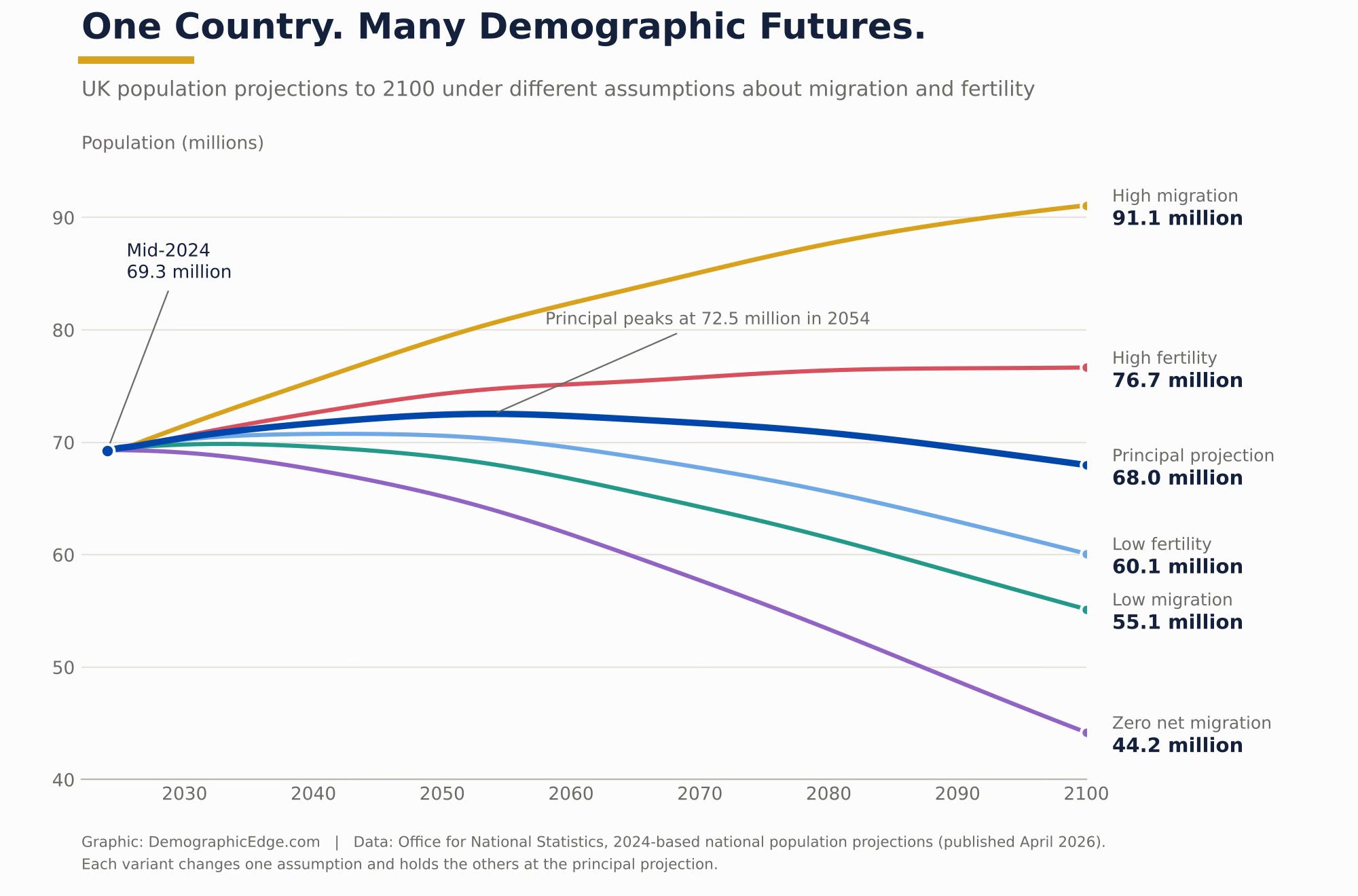
The United Kingdom has about 69 million people today. By 2100 it could have 44 million. Or 91 million.
Both numbers come from the same official source, the Office for National Statistics’ (ONS) latest population projections. Look at the chart above. Same country, same starting point. Change the assumptions about migration and fertility, and nearly 47 million people appear…or disappear.
I've spent decades telling audiences that, unlike economics or technology, demography is destiny. But destiny, it turns out, has a timeline.
I like a good metaphor. Think of demography as a river. Its course is shaped by forces already in motion, and we can generally map where it will flow. But dams and canals can still change where a river goes. The catch is time.
Over the next 10 or 20 years, most of the demographic future is already here. The workers, households, and customers who will define the markets of the 2030s and 2040s have largely been born. For any business deciding where to invest in people, products, or infrastructure, that future should already be inside the planning cycle.
Look 50 or 100 years out and the picture changes. Choices about migration, family, health, and how people live compound across generations. Very different countries become possible.
Even the ONS illustrates the point. In its previous projections, the UK's population kept growing until the 2090s. The new ones have it peaking in 2054 and then shrinking. Change the assumptions, and the long-run story flips.
Demography is both a short game and a long game. In the short game, we adapt to a future already in view. In the long game, what we decide now shapes the future that follows.
Here is the irony. The demographic future we can see most clearly is the one we can least change. The one we can change most is the one we can see least clearly.
Demography may be destiny. It helps to know which destiny you’re talking about.