

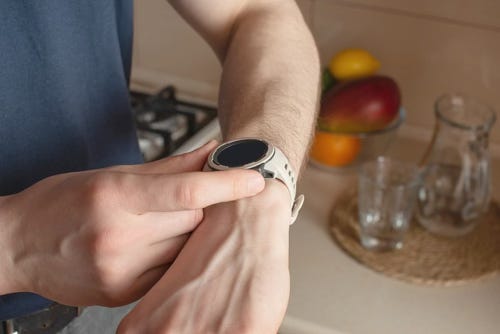
Your watch thinks you slept poorly. Your ring agrees. You thought you were having a perfectly good morning. Then you notice your recovery score is down and wonder: Do I really feel okay?
Welcome to a health market that doesn’t require you to feel sick.
Gen Z and millennials make up about 36% of U.S. adults but account for roughly 41% of annual wellness spending, according to McKinsey’s Future of Wellness research. Its definition reaches well past medicine, into sleep, appearance and mindfulness.
The familiar question “What’s wrong?” now has company.
I feel fine. Could I feel better?
Rings track sleep. Watches estimate cardiovascular fitness, and sensors offer a running log on what lunch does to blood glucose. Biomarker panels, full-body scans and longevity clinics provide an up close look inside bodies that haven’t reported so much as a bellyache.
Some people arrive with symptoms. Others arrive with a credit card and a suspicion that “fine” leaves room for improvement. Some treat it like a leaderboard: How do I get my numbers up?
Why Younger Adults Invest in Feeling Better
Younger adults grew up surrounded by scores: steps, followers, credit ratings, screen time. A sleep score is just one more. That doesn’t mean they feel invincible.
McKinsey points to reported burnout and a steady stream of wellness content on social media as possible explanations for their interest. A person buying better sleep may simply be trying to get through the week, not plotting a 100th birthday party decades away.
The horizon matters too. At 35, strength and metabolic health can support decades of work and family life still ahead. You don’t have to call yourself a biohacker to want more good years.
The economist Michael Grossman described health as a form of capital more than half a century ago. We draw it down, and we can build it back up. Today, that capital has a balance statement. It vibrates on your wrist, often several times a day.
The ambition shifts across life. Someone in their 30s may want more energy after work. Someone in their 70s may want to keep hiking, or simply have the stamina to chase a 5-year-old grandchild. Both are investing in capacity for something they want to do.
The Expanding Household Health Budget
The spending goes well beyond gadgets. A November 2025 KFF poll found that current GLP-1 use was highest among adults ages 50 to 64, and that 27% of insured users had paid the full cost themselves. These drugs treat conditions including diabetes and obesity, so paying cash can reflect a coverage gap as much as a consumer choice. Either way, it’s a new monthly bill, sitting next to the electric bill and Netflix.
Households have long paid for gyms and supplements. Now their health budgets reach into territory once largely confined to clinics: diagnostics and the work of making sense of the results. Was that shadow on the scan just a shadow?
Next to premiums and copays sit the trainer, the wearable subscription and the test insurance won’t cover. Those purchases compete with vacations, home repairs, even retirement savings, and in a household of one, there’s no second income to absorb them. They also demand time. A gym membership takes seconds to buy. Using it requires getting up on a cold morning and rearranging Tuesday.
3 Health Portfolios, 1 Question
In my recent Barron’s piece, and in a companion peer-reviewed paper forthcoming in Retirement Management Journal, I proposed thinking about health investments as three portfolios with different jobs.
A preventive portfolio maintains the baseline through exercise, sleep, vaccinations and screenings. It’s the “just keep me well” investment.
A performance portfolio seeks capacity beyond the typical baseline for one’s age, through training, nutrition and the technologies that guide them. This is where much of the emerging longevity market makes its pitch.
A protective portfolio addresses illness and its consequences, from treatment and rehabilitation to the support needed to live well with a condition. It’s the one most of us picture when we think about health.
The boundaries blur. Strength training can serve all three. What matters is the question underneath: What do I expect this investment to help me do?
That question applies to time as much as money. An expensive device may contribute less than a daily walk. A test may change a treatment decision, or simply supply another number to worry about, leading to, you guessed it, another test.
What Health Consumers Want Their Money to Do
The demographic change is in when people enter the market and what they expect from it. Younger consumers don’t have to wait to be sick to become customers. Older consumers may be managing a condition while also pursuing greater strength or mobility.
Age alone tells a company little about the ambition behind a purchase. A 35-year-old and a 65-year-old may want the same outcome, with different starting points.
Consumers now arrive with data and purchases already in hand. A clinician may be asked to interpret numbers collected elsewhere. A fitness coach may need to explain why a client feels stronger while their wearable says otherwise. A technology company faces the question its dashboard leaves unanswered: What should I do with this?
Employers are not simply bystanders. Employees’ out-of-pocket purchases can reveal demand that the benefits package may miss.
Some purchases will prove useful: a nudge that gets someone walking, an early warning worth acting on. Others will deliver anxiety, or a drawer full of well-intentioned gadgets. Evidence has to earn its place next to enthusiasm.
“I feel fine” once helped end a healthcare conversation. Increasingly, the conversation starts with a buzz on the wrist.